

Introducing Sea-Glass: Multi-Item AI Donation Sorting
August 20, 2026
How Thrift Organizations Are Using AI to Sort Donations Smarter
October 15, 2026
How to Price Thrift Store Items: A Practical Pricing Strategy
Thrift stores face a pricing challenge traditional retailers rarely encounter: nearly every item is different, but teams still need to process thousands of donations quickly.
Research every item and production slows down. Price everything the same way and valuable merchandise can slip through underpriced.
A strong thrift store pricing strategy balances both. Standardize predictable inventory, spend more time on items where additional research could materially change their value, and use sales data to continually improve pricing decisions.
The goal isn’t necessarily to get the highest possible price for every donation. It’s to maximize the value of the entire donation stream while keeping inventory moving.
In this article
What is a good thrift store pricing strategy?
A strong thrift store pricing strategy balances processing speed, customer affordability, sell-through, and value recovery. Many organizations use standardized category or brand pricing for predictable inventory while individually evaluating items with unusual, collectible, premium, or e-commerce potential.
How does Goodwill price items?
Goodwill pricing varies by local organization. Goodwill Industries International supports a network of 150 local Goodwill organizations, and individual organizations can establish their own retail and pricing practices. For example, Goodwill Industries of the Valleys uses category-based pricing ranges and gives employees discretion to select an appropriate price within those guidelines.
How much should thrift stores charge?
There is no universal percentage or price. Thrift store pricing should account for category, condition, brand, local demand, resale market value, sales channel, and how quickly the organization needs inventory to turn. Tools like pearldive Ama Sorter can help teams quickly make pricing and routing decisions based on updated market values.
How to price thrift store items
Unlike traditional retailers, thrift stores usually process donated goods one item at a time. To remain efficient, they have to balance pricing accuracy against labor and processing time.
Consider a 20-item batch of clothing.
Pricing all 20 pieces at a standard $5 may move merchandise to the sales floor quickly, but it can also underprice the occasional high-value item.
Researching all 20 individually may capture more value, but if each item takes several minutes to identify, compare, and price, production slows. Multiply that across thousands of donations and the additional labor can quickly outweigh the value recovered.
The goal is therefore not maximum research. It’s knowing which items deserve additional research.
Many thrift operations address this with an exception-based approach: process predictable inventory using established pricing rules while routing unusual, potentially valuable, or difficult-to-identify merchandise for additional review.
Well-trained employees and category experts have traditionally filled that role. The problem is that relying heavily on individual knowledge can create bottlenecks when an experienced employee isn’t available.
Modern thrift technology can help organizations make those decisions more consistently without slowing production.
How does Goodwill price items?
Although Goodwill is a nationally recognized name, retail operations are managed locally. Goodwill Industries International supports a network of 150 locally led Goodwill organizations, so there isn’t one universal Goodwill pricing policy used by every store.
Goodwill Industries of the Valleys offers a useful example.
The organization says its pricing system provides employees with a range of 5 to 10 prices within an item category rather than automatically assigning a price based on brand. Employees then use their judgment to determine the appropriate price.
Why not research everything? Because of time.
Goodwill Industries of the Valleys says researching every individual item would slow intake and interfere with its priority of getting fresh inventory onto the sales floor. Employees instead receive pricing guidelines, ongoing training, and discretion to make decisions about what belongs on the floor.
This is a fundamental challenge of donated-goods retail: pricing time has a cost, too.
A pricing system has to recover value without becoming a bottleneck.
Developing a realistic thrift store pricing strategy
Most thrift stores need several pricing methods. There are multiple thrift store pricing strategies available where operators can mix and match to create a specific system that works best.
Item prices can be based on:
- Category pricing
- Brand or tiered pricing
- Individual-value pricing
- E-commerce routing
- Markdown and outlet pricing
Condition, market demand, local customer behavior, and resale value influence each of these decisions.
The strongest system determines when speed matters most and when additional evaluation is worth the effort.
Condition, market value, and market demand in pricing
While an item’s condition, value, and demand will influence the price you ask for an item, they’re not a pricing strategy in themselves. Instead, they are factors that influence the pricing decision made in each strategy.
For more info on determining market value and understanding current trends, download our free Goodwill Buyer’s Guide.
Category Pricing
Category pricing works well for high-volume, relatively predictable merchandise.
That might include:
- Standard T-shirts
- Common paperback books
- Basic kitchenware
- Common housewares
- Everyday accessories
An organization might set one price for all standard T-shirts or establish several prices based on condition or quality.
For example:
- Standard T-shirt: $5
- Like-new T-shirt: $7
The exact prices will vary by organization and local market. The important part is that employees don’t have to research every item before making a decision.
The advantage: Speed and consistency.
The risk: Outliers can get missed. A valuable vintage shirt, rare piece, or premium product may look like ordinary category inventory if employees don’t recognize it.
Brand and Tiered Pricing
For categories where brand materially affects customer demand, stores can add another layer.
A simple system might establish:
- Standard tier: everyday or lesser-known brands
- Premium tier: recognizable brands with stronger resale demand
- Research tier: designer, luxury, vintage, or unusual merchandise
This allows teams to capture more value without individually researching every item that enters the building.
The advantage: More pricing flexibility while maintaining processing speed.
The risk: The strategy still depends on employees recognizing the brand and understanding which tier it belongs in.
The downside is that brands change. A label that commanded strong resale demand several years ago may become oversupplied, while an unfamiliar or newly popular brand may suddenly have substantial value.
That makes static brand lists useful, but imperfect.
Individual-Value Pricing
Some items deserve additional attention.
Rare, unusual, collectible, designer, vintage, or potentially high-value goods may be worth researching individually rather than placing into a broad category or brand tier.
Traditionally, this creates a bottleneck.
An employee may need to:
- Identify the item
- Determine its brand or model
- Search for comparable products
- Estimate condition
- Understand current market demand
- Decide how much to charge
- Determine where it should be sold
That can take several minutes or considerably longer for difficult items.
Thrift-specific AI can help reduce some of that manual research.
pearldive Ama Sorter uses item images and relevant market information to help employees identify products, brands, categories, and potential value. Recommendations can then be based on the organization’s own rules, sales channels, and operating model.
Sea-Glass extends that approach to groups of inventory, allowing employees to analyze a cart, rack, gaylord, or other collection of donated goods rather than researching items one by one.
The goal isn’t to research everything more deeply, but to identify the exceptions faster.
The advantage: Greater opportunity to capture the value of unusual or high-potential donations.
The risk: Individual research traditionally requires the most labor and expertise. Technology can reduce that burden, but employees still need clear organizational pricing and routing rules.
E-Commerce Routing
Pricing and sales channel decisions are closely connected.
A $40 item in one local store may have substantially more potential when introduced to thousands of interested buyers online.
That is particularly relevant for items such as:
- Collectibles
- Musical instruments
- Jewelry
- Designer fashion
- Specialty electronics
- Rare books
- Vintage goods
- Niche hobby products
Goodwill’s own online marketplace demonstrates the breadth of inventory that can move through an e-commerce channel. ShopGoodwill includes products from clothing and jewelry to instruments, collectibles, art, books, toys, and home décor supplied by local Goodwill organizations.
For these items, the correct pricing decision sometimes starts with the correct channel decision.
An unusual collectible may have limited demand within a store’s local customer base but a much larger audience online.
That doesn’t mean every high-value item belongs in e-commerce. Online inventory carries additional processing costs, including photography, listing, storage, fulfillment, marketplace fees, and shipping.
The organization needs to determine whether the item’s online value justifies that additional work.
The advantage: Niche and valuable merchandise can reach a much larger pool of buyers.
The risk: E-commerce adds additional operational costs and processing steps.
Connected systems can reduce some of that friction. Within The Complete Thrift Ecosystem, items identified for online sale can move from sorting and routing into Upright Lister rather than requiring teams to recreate information at each step.
Markdown and Outlet Pricing
The right price on day one may not be the right price two weeks later.
Markdown strategies help thrift stores move aging inventory, free valuable floor space, and create room for new donations.
Stores may use:
- Color-tag rotations
- Scheduled percentage discounts
- Category promotions
- Store-wide sales
- Progressive markdowns
For example:
- Week 1: Full price
- Week 2: 25% off
- Week 3: 50% off
- Final disposition: Outlet, salvage, recycling, or another recovery channel
The exact timing varies by organization.
What matters is treating markdown as part of the inventory lifecycle, not simply as a last attempt to generate revenue.
An item occupying floor space for too long has a cost.
If merchandise remains after its retail lifecycle, moving it to an outlet or salvage channel may still recover value while freeing capacity for newer inventory.
Solutions DGR POS supports thrift-specific workflows including color rotations and discount management, while its Production and reporting tools allow organizations to connect pricing decisions with what actually happens at the register.
Condition, Demand, and Market Value Still Matter
Category, brand, individual research, and channel selection are pricing methods. Meanwhile condition, demand, and market value help determine the price within those methods.
Consider two identical jackets. One is like new and the other has substantial staining and wear.
They shouldn’t necessarily receive the same price simply because they fall into the same category and brand tier. Likewise, a product with a $50 asking price online isn’t necessarily “worth $50.”
Thrift operators need to distinguish between:
- Asking price
- Actual selling price
- Current buyer demand
- Local demand
- Online demand
- Condition
- Competition
- Time required to sell
Market value is only useful when paired with the reality of whether someone is actually likely to buy the item.
How Do You Know If Your Pricing Strategy Is Working?
This is where pricing gets more interesting. A price is essentially a hypothesis: “We believe this item will sell at this price.”
You don’t know whether that decision was correct until you see what happens afterward.
That means a strong pricing system needs a feedback loop. Thrift operators should be able to answer questions such as:
- Did the item sell?
- How long did it take?
- Did it sell at full price?
- Was it marked down?
- Which category was it in?
- Which store sold it?
- Who processed and priced it?
- Are certain categories consistently priced too high or too low?
- Which processors are putting the greatest value on the floor—not just the greatest number of items?
This is where item-level data can substantially improve pricing decisions.
Solutions DGR Production uses serialized barcodes to give individual donated goods unique identifiers and connect production information to what ultimately happens at the point of sale. Organizations can analyze how quickly an item sold, its actual selling price, discounts, store performance, and processor performance.
That creates evidence about whether your pricing strategy actually worked.
How to Price Donations in Your Thrift Store
So, how should your thrift store price donated goods? For most operations, the answer isn’t choosing between speed or accuracy. It’s creating a system that knows when each matters most.
Use standardized pricing for predictable, high-volume merchandise. Add brand and condition tiers where they materially affect value. Spend additional research time on items where the payoff may justify it. Route merchandise to e-commerce when online demand creates a stronger opportunity. Use markdowns to manage aging inventory. Then measure what actually sells and feed those results back into the process.
The goal isn’t to maximize the selling price of every individual item. It’s to maximize the value of the entire donation stream. Technology can help make that system more consistent.
Solutions DGR connects production and point-of-sale data so donated goods can be tracked from pricing through final sale. Serialized inventory helps organizations understand sell-through, actual selling price, markdowns, store performance, and processor results.
pearldive adds decision support earlier in the process by helping employees identify unusual or potentially valuable merchandise and determine whether an item should remain in retail, receive additional review, or move into e-commerce.
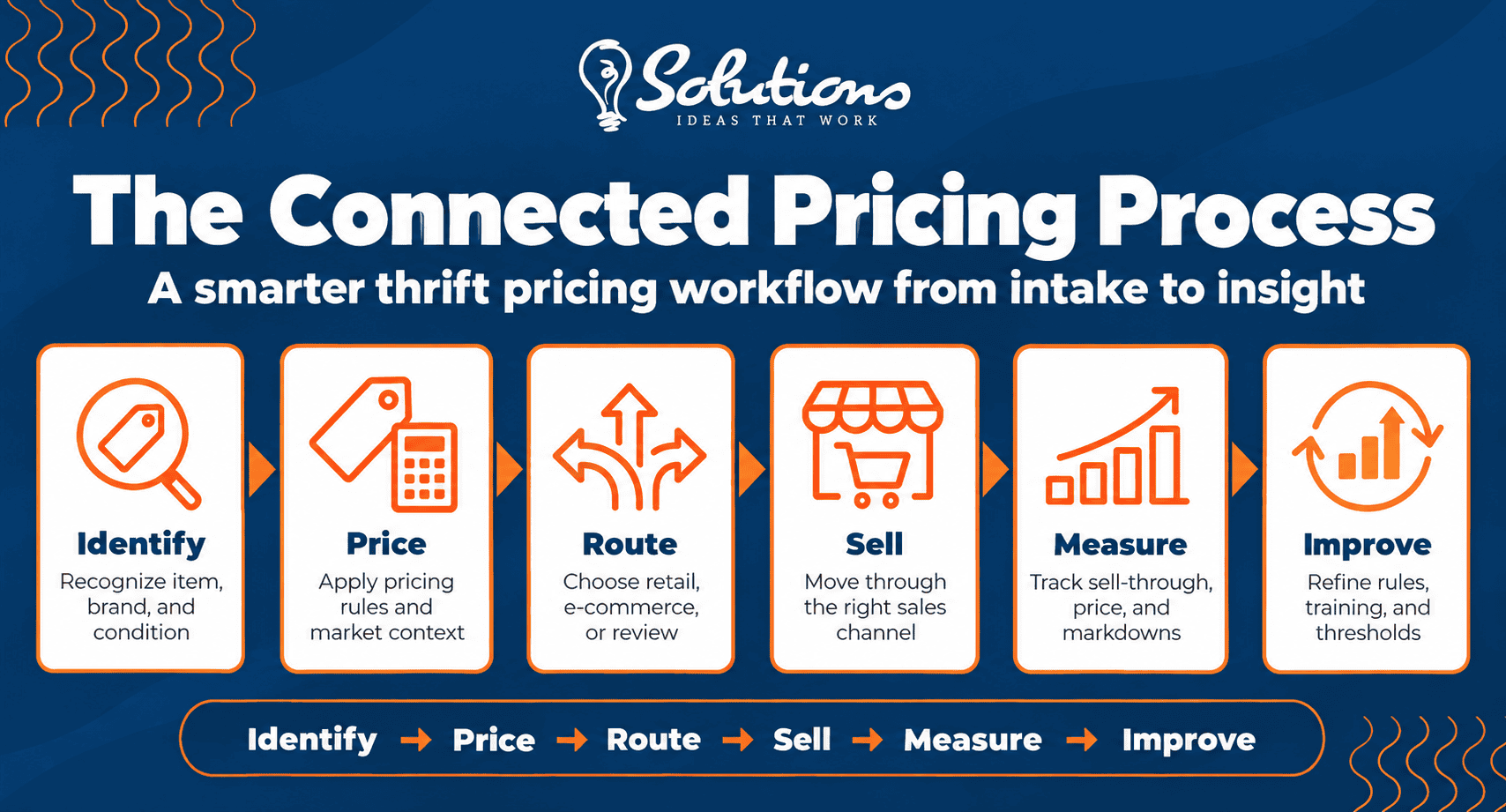
Together, those capabilities create a more connected pricing process: Identify → Price → Route → Sell → Measure → Improve.
Want to see what that kind of connected operation can look like across intake, production, POS, and e-commerce? Download the Goodwill Buyer’s Guide.
Or estimate the potential impact of better sorting and routing decisions with the pearldive Ama Sorter ROI Calculator.